
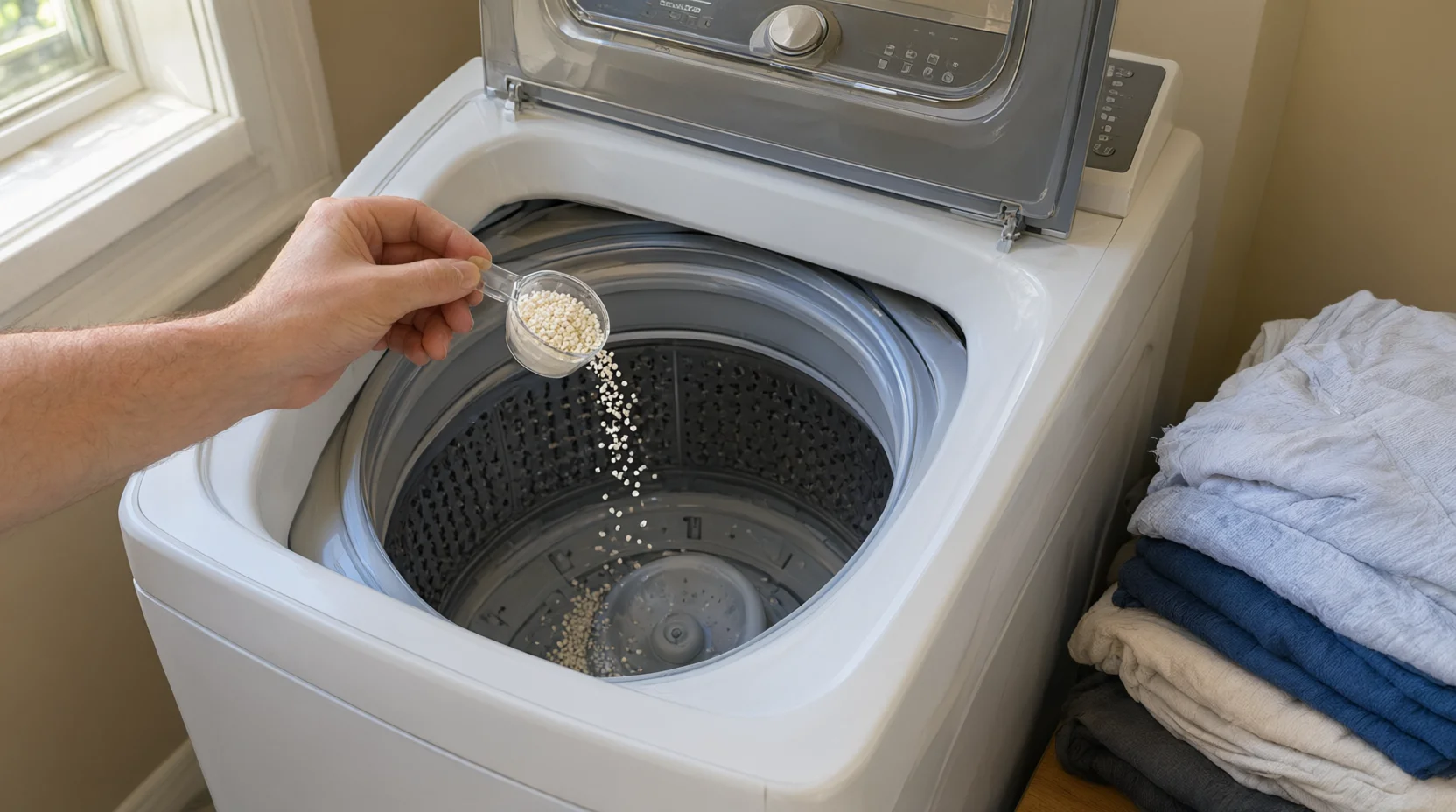
Scatter the measured scent beads across the bottom of the empty drum, then load your clothes on top. In a top-load washer with a center agitator, this order matters more than it does in many other machines: beads that land on top of a full load can get pressed into fabric by the agitator before they have a chance to dissolve. Beads-first placement, a loosely packed drum and the dose printed on the product label are the three conditions that give the beads the best chance of dissolving completely.
Why Placement Matters with a Center Agitator
A center agitator is designed to move clothes through the wash water, and it concentrates that mechanical action near the middle of the drum. That is useful for cleaning, but it works against a loose additive. If beads sit on the surface of the load, the agitator's twisting motion can drag them down against the post or wedge them into folds of fabric, where water reaches them slowly.
Water contact is the whole mechanism here. Scent beads are a fragrance-only additive: they dissolve in the wash water to release scent, and they do not clean or soften fabrics. A bead that stays trapped against fabric has limited contact with moving water, so it dissolves unevenly or not at all. In deep-fill and heavy-duty cycles, the larger water volume helps, but the increased fabric movement can also bury loose beads deeper in the load.
The Correct Order: Beads First, Then Clothes
The sequence is short, and each step has a reason behind it. Start with a completely empty drum, add the beads, and only then load the washer.
- Measure the beads according to the product label, adjusting for load size as the label directs. Do not guess upward; adding more beads does not make them dissolve more reliably.
- Scatter them across the drum bottom rather than pouring them in one pile near the base of the agitator. A spread-out layer meets the incoming water over a wider area.
- Load clothes loosely around and over the agitator. Clothes should be able to move; packing them in tightly restricts the circulation the beads need.
- Add detergent according to its own instructions. Laundry pods go into the drum, while liquid or powder detergent may go in the dispenser if your machine has one. Scent beads are not a substitute for detergent and should never go in the dispenser drawer.
This order also answers a common question: adding fragrance booster beads before or after the clothes is not a matter of preference. Adding them before is the placement that gives the beads direct contact with incoming water; adding them after is the placement most likely to leave them stranded on fabric.
What Happens When Beads Go in After Clothes
If you pour beads over a loaded drum, they settle between garments instead of reaching the drum floor. Water has to work through layers of fabric to reach them, and the agitator pushes surface beads toward the center of the load, where water penetrates most slowly. The result is the familiar complaint that scent beads do not dissolve in a top-load washer: small sticky spots, clumps in hems and cuffs, or a faint gritty feel on the finished laundry.
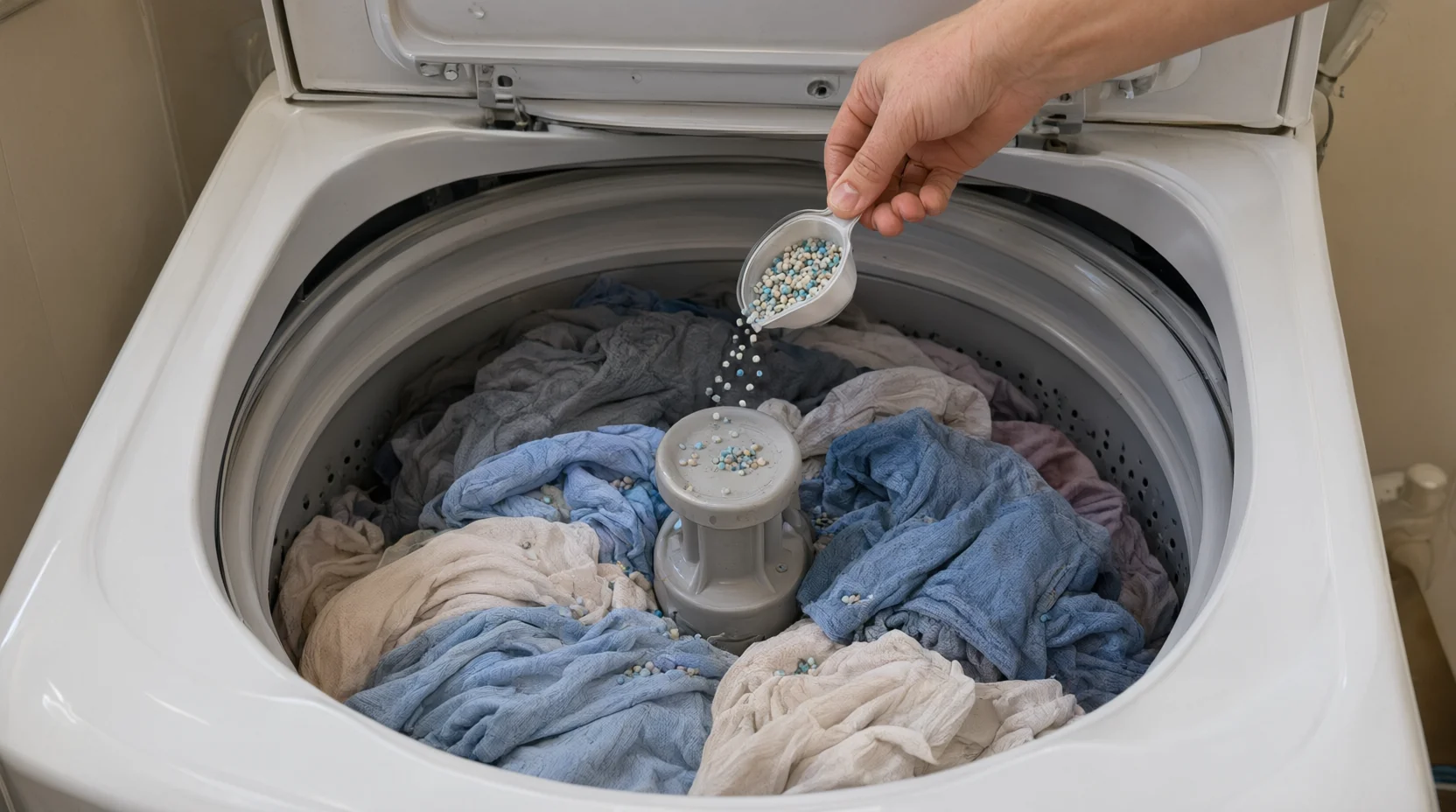
Cold water makes this worse. Beads are generally formulated to dissolve in cold cycles, but they dissolve more slowly in cold water than in warm, so a cold load combined with poor placement stacks two disadvantages. Some fabrics may also hold undissolved fragments more readily than others, depending on how tightly the load is packed and how much water circulates through it.
Deep Water Wash and Heavy Loads: Extra Checks
A deep water wash does not automatically solve a dissolution problem. If the drum is overloaded, fabric movement is restricted no matter how much water the machine adds, and beads can stay trapped. For very large loads, splitting the laundry into two standard loads is usually more effective than adding more beads.
If beads consistently fail to dissolve, check three things before blaming the product:
- Water temperature. Follow the temperature guidance on the bead label and your machine's cycle settings. Many beads are formulated to dissolve in cold water, but the label governs for the specific product.
- Agitator movement. Make sure the agitator turns freely and is not binding, since a stalled agitator reduces the water movement that helps dissolve the beads.
- Load size. Confirm that the drum is loosely filled rather than packed, and reduce the load if the clothes cannot tumble or circulate.
If Beads Still Stick or Leave Residue
When residue appears despite correct placement, start with the simplest fixes. Reduce the amount per load to the label's minimum and confirm that the drum is not packed tight when dry. Avoid combining very cold water with very large loads at the same time, since that pairing gives the beads the least favorable conditions.
Check the finished laundry before moving it to the dryer. Items with visible residue can be rewashed on a warm-water cycle without adding more beads; heat from drying can set sticky spots and make them harder to remove. If the problem persists under reasonable conditions, it may reflect a formulation-specific behavior, and the product manufacturer's guidance is the right next step.
For related questions, see our guides on how many laundry scent beads to use and where to put them and why laundry scent beads leave residue or lose their scent.
Quick Reference: Placement by Washer Type
| Washer type | Placement | Main risk if misplaced |
|---|---|---|
| Top-load with center agitator | Scatter them across the bottom of the empty drum before loading | The agitator can press beads into folds of fabric |
| Top-load without an agitator | Bottom of the empty drum before loading | Beads settle on top of the clothes and dissolve unevenly |
| Front-load | Back of the empty drum before loading | Beads collect in the door seal or on fabric surfaces |
These placement practices apply generally to in-wash fragrance beads. How well the beads dissolve depends on the formulation and on the conditions of each wash, so always follow the product label and your machine's instructions.
Takeaway
In a top-load washer with a center agitator, the reliable routine is to add the beads first, scatter them across the empty drum, then load the washer loosely and use the dose stated on the label. If residue still appears, check the load size, water temperature and agitator movement before switching products. Correct placement addresses many common residue problems; any that remain usually point to wash conditions or a formulation-specific behavior that the label and manufacturer guidance can help clarify.