
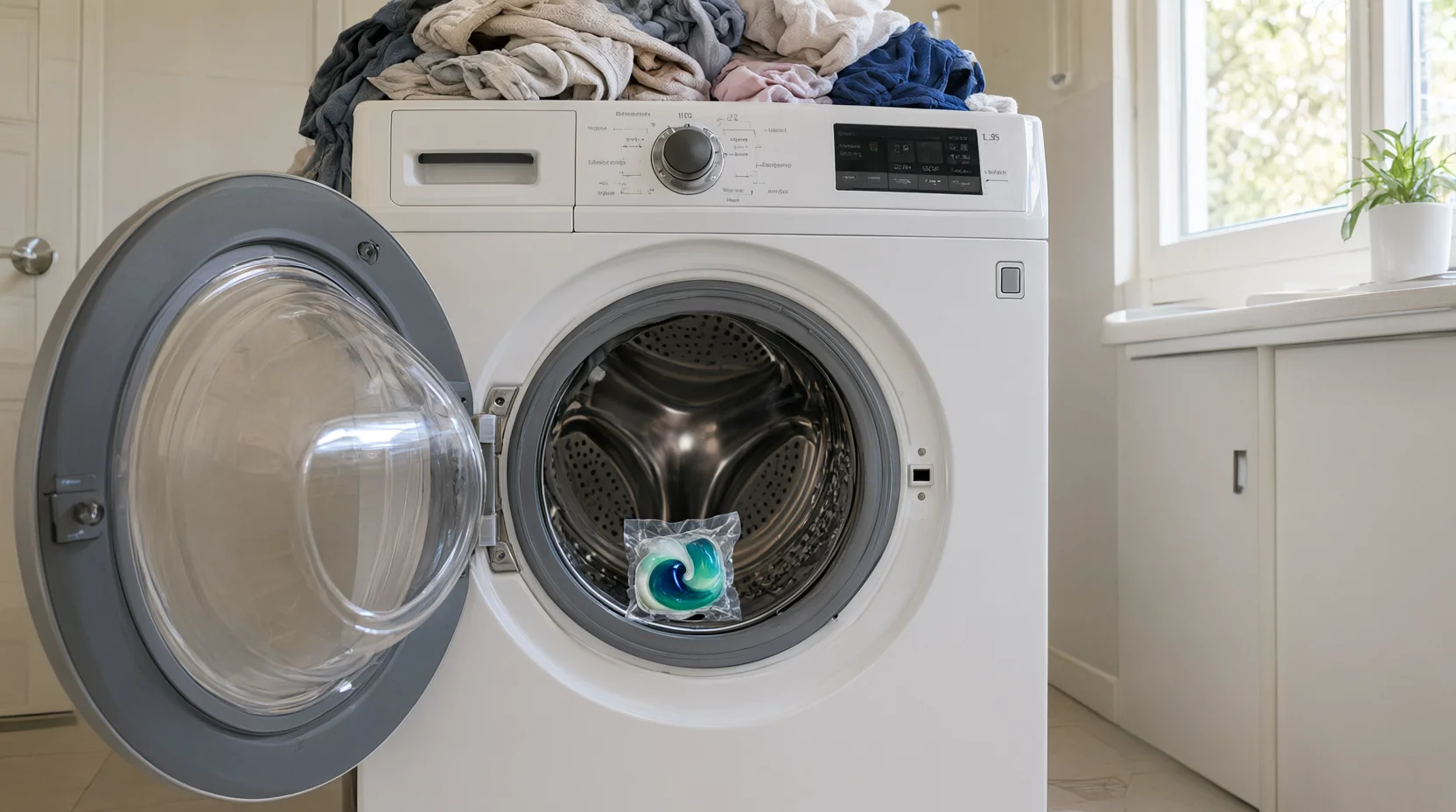
Laundry pods can work in a quick or short wash cycle, but there is less room for error than in a standard cycle. For the pod to dissolve, it must be fully submerged, the drum must have room for water to circulate, and the cycle must provide enough water contact and agitation for the water-soluble film to break down. If any of these conditions is not met, you are more likely to find gel residue on clothes or inside the drum. Liquid detergent is more forgiving in very short or cold quick washes because it has no film barrier to dissolve.
Why Quick Cycles Challenge Pod Dissolution
A quick wash compresses the same basic steps as a normal cycle — fill, wash, rinse, spin — into less time. That usually means less total water exposure and fewer water exchanges. For a pod, the film must first dissolve in the wash water before the concentrated detergent inside can be released. Shortening the wash phase reduces the window in which that can happen.
Cold water adds a second constraint. Water-soluble film generally dissolves more slowly in cold water than in warm water, and a quick cold program combines the shortest exposure time with the least favorable temperature. This is a general principle of how film-wrapped pods behave, not a statement about the dissolution time of any particular product. Always follow the pod manufacturer's instructions on water temperature and cycle type.
How to Use Laundry Pods in a Quick Wash
Most residue problems in short cycles come down to placement and load size rather than the pod itself. The steps below give the pod the best chance of dissolving fully.
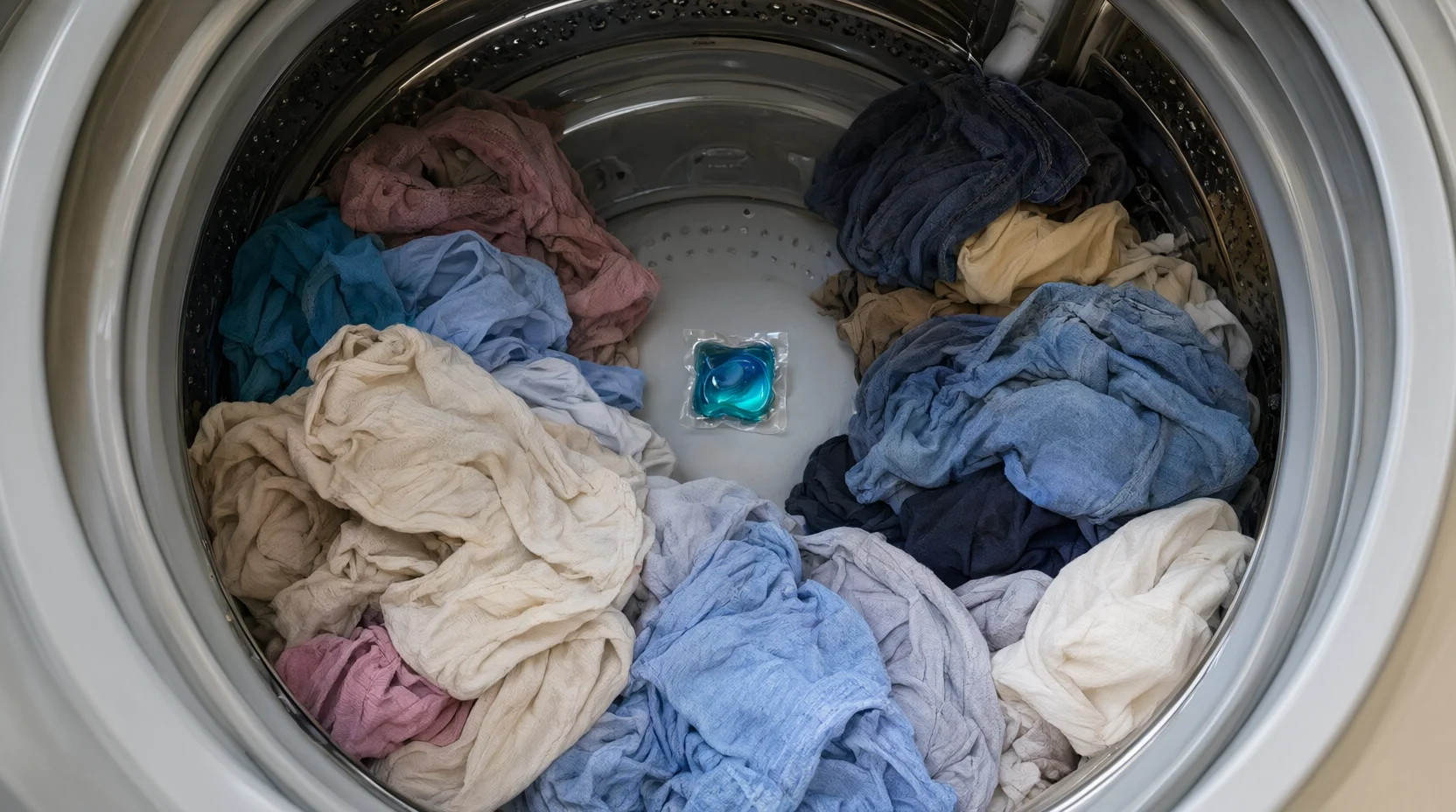
- Place the pod in the empty drum first. Put it at the back of the drum, then add clothes on top. Do not put pods in the detergent dispenser drawer — the drawer does not deliver enough water to dissolve the film reliably.
- Leave room in the drum. An overloaded drum presses clothes against the pod, trapping it in folds where water cannot reach it. A drum that is roughly three-quarters full leaves space for the pod to move and for water to circulate.
- Check that the pod is not caught in clothing. Before starting the cycle, make sure no garment is wrapped around the pod. Items with deep pockets or heavy folds are the usual culprits.
- Use the water temperature the pod instructions specify. If the label allows a range, a warmer setting within that range gives the film more favorable conditions than the coldest option.
- Check what the quick program actually does. Some quick programs run for under 30 minutes and use less water; others are closer to a standard cycle with a shorter main wash. If your machine's shortest program gives very little fill and agitation time, a standard cycle may be the more reliable choice for pods.
When Pods May Not Dissolve Fully
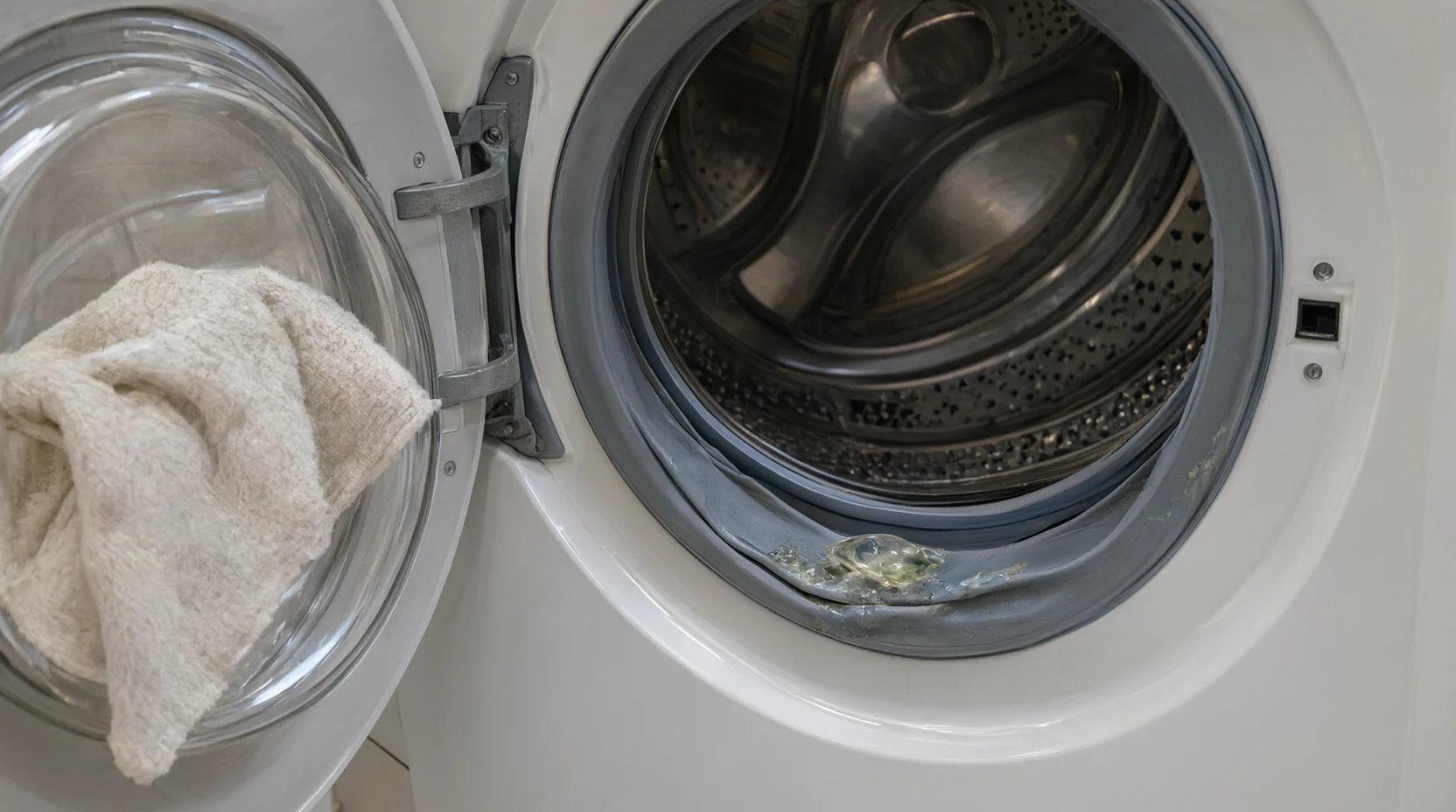
Partially dissolved pods usually leave a gel-like residue rather than a dry powder. The residue can cling to fabric, sit in the drum, or collect around the door seal on a front loader. The common causes are mechanical, not chemical.
- The pod was trapped. A pod caught in a pocket or a tight fold of fabric receives far less direct water contact than one sitting free in the drum.
- The drum was overloaded. Clothes packed tightly restrict water movement and can trap fragments of film against the fabric until the cycle ends.
- The cycle was very short or very cold. Shortened rinse and spin sequences in economy quick programs leave less time for the film to break down and be rinsed away.
- The pod was added after the clothes. Dropping a pod on top of a full load often means it sits on the fabric instead of in the water at the bottom of the drum.
If residue keeps appearing even with correct placement and load size, the quick program itself may be the limiting factor. Our guide to why laundry pods leave residue and how to fix it covers the wider troubleshooting sequence.
Laundry Pods vs Liquid Detergent for Quick Washes
Both formats can be used in a quick wash, but they tend to fail in different ways. Liquid detergent mixes into the wash water as soon as the drum fills, so it does not depend on a film dissolving. Laundry pods offer fixed, pre-measured dosing with no pouring, but that convenience depends on the film breaking down within the cycle.
| Comparison point | Laundry pods | Liquid detergent |
|---|---|---|
| How it enters the wash water | The film must dissolve before the detergent is released | Mixes immediately on contact with water |
| Dosing | Fixed per pod; cannot be adjusted for small loads | Adjustable to load size and soil level |
| Sensitivity to very short or cold cycles | Higher — less time and lower temperature for the film to dissolve | Lower — no film barrier to dissolve |
| Main user-dependent risk | Placement and load size | Over- or under-dosing |
This table covers handling differences, not cleaning performance. Whether a pod or a liquid cleans better in a given quick cycle depends on the formula concentration, the soil level, water hardness and the specific machine program. No general claim of superiority can be made without formulation-specific testing, and none is made here.
For a broader comparison of the two formats beyond the quick-cycle question, see laundry pods vs liquid detergent.
What to Do If You Find Undissolved Pod Residue
Act before the residue dries. A gel deposit that goes through the dryer can set into the fabric and become harder to remove.
- Do not tumble dry the affected items. Rewash them in a standard cycle at a water temperature the fabric care label allows.
- Wipe the drum and door seal. Remove any gel residue with a damp cloth before running the next load.
- Check the load before rewashing. Confirm the drum is not overfull and that the pod will sit free in the empty drum.
- Reassess the cycle. If residue recurs on the same quick program despite correct technique, use a longer cycle for pods or switch to a format that does not rely on film dissolution.
Choosing a Format for Fast Washes
If your routine is built around short, cold quick washes and you want the least fuss, liquid detergent or laundry sheets remove the film-dissolution variable. If you prefer pre-measured dosing and your quick program is not extremely short, pods can work well provided you place them in the empty drum, keep the load loose and follow the label's temperature guidance.
For very small quick loads — just a few items refreshed in a hurry — a fixed-dose pod may also deliver more detergent than the load needs, while liquid lets you scale down. Matching the dose to the load is part of getting a clean result, as covered in our guide to reading detergent dosing instructions.
The practical takeaway: pods are not inherently unsuitable for quick cycles, but they depend more on correct technique than liquids do. Place the pod first, load loosely, follow the label's temperature guidance, and if residue persists, treat the cycle length as the likely cause rather than assuming the pod is faulty.