
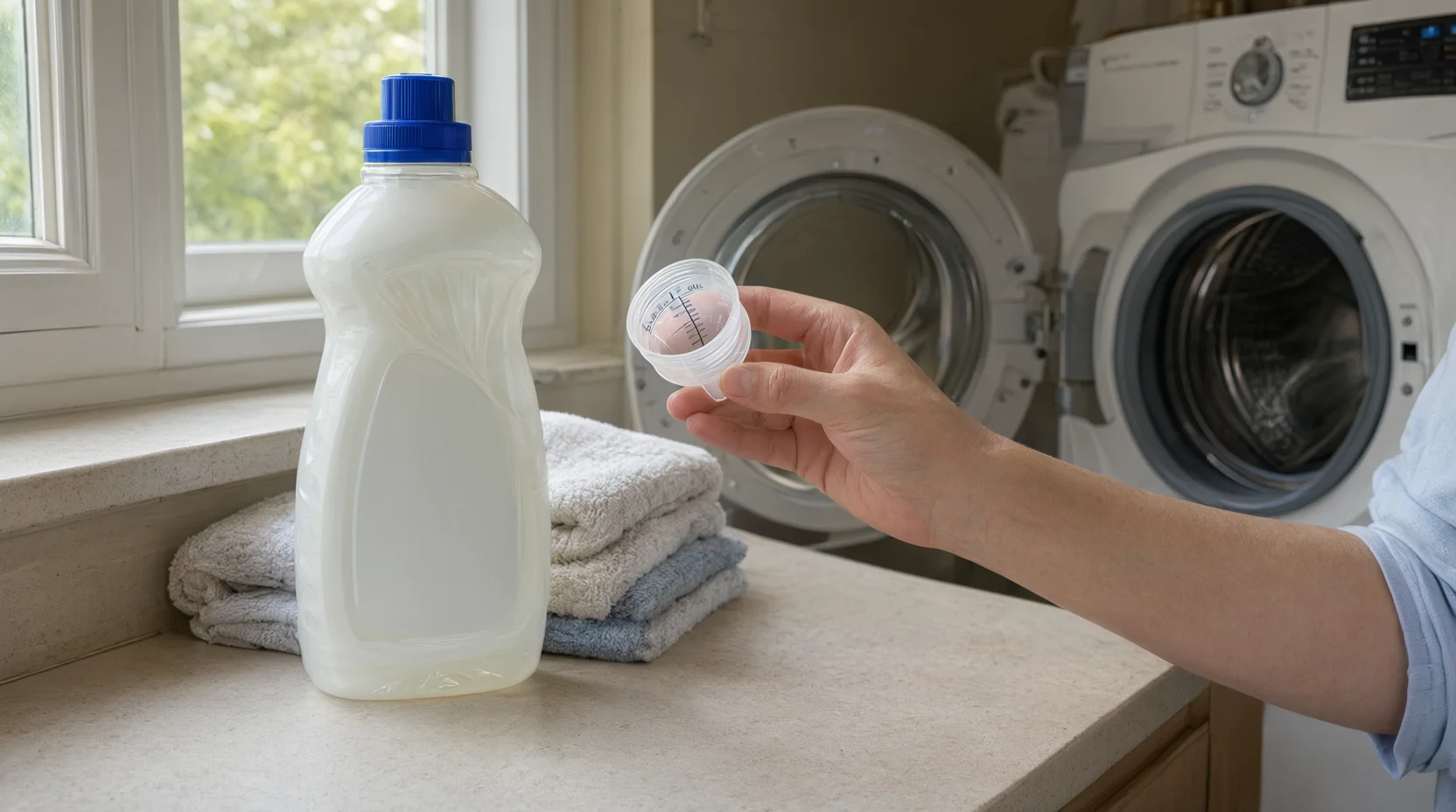
Detergent labels give you a starting dose based on load size, soil level, and washer type, but the right amount for your machine also depends on its water volume, your water hardness, and whether the detergent is concentrated. High-efficiency (HE) washers need HE-formulated detergent and generally less volume than standard machines. Always check the product's specific markings rather than filling the cap to the top.
What Detergent Labels Actually Tell You
Dosing information is usually printed on the back or side of the package, often in a table or a short list. Labels typically organize the dose by load size—small, medium, large—and sometimes by soil level, such as normal versus heavily soiled. These are starting points, not fixed rules for every home.
If the label says the formula is concentrated, it will require substantially less product than a standard formula for equivalent cleaning. The word "concentrated" or a multiple like "2x" is your cue to measure carefully; pouring the same volume as a regular detergent can leave residue and waste product.
An HE symbol means the detergent is compatible with high-efficiency machines. It does not necessarily mean the dose is different from the same brand's regular version—it means the formula is low-sudsing and designed for low-water washing. Check the label's own dosing table for that specific product.
Reading Measuring Caps, Scoops, and Pre-Measured Forms
Liquid detergent caps double as measuring cups, but the markings are often faint and hard to see. Hold the cap up to a light to find the internal lines and numbers. Those lines correspond to load sizes—not to the top of the cap. Filling to the brim usually exceeds the recommended dose for a normal load.
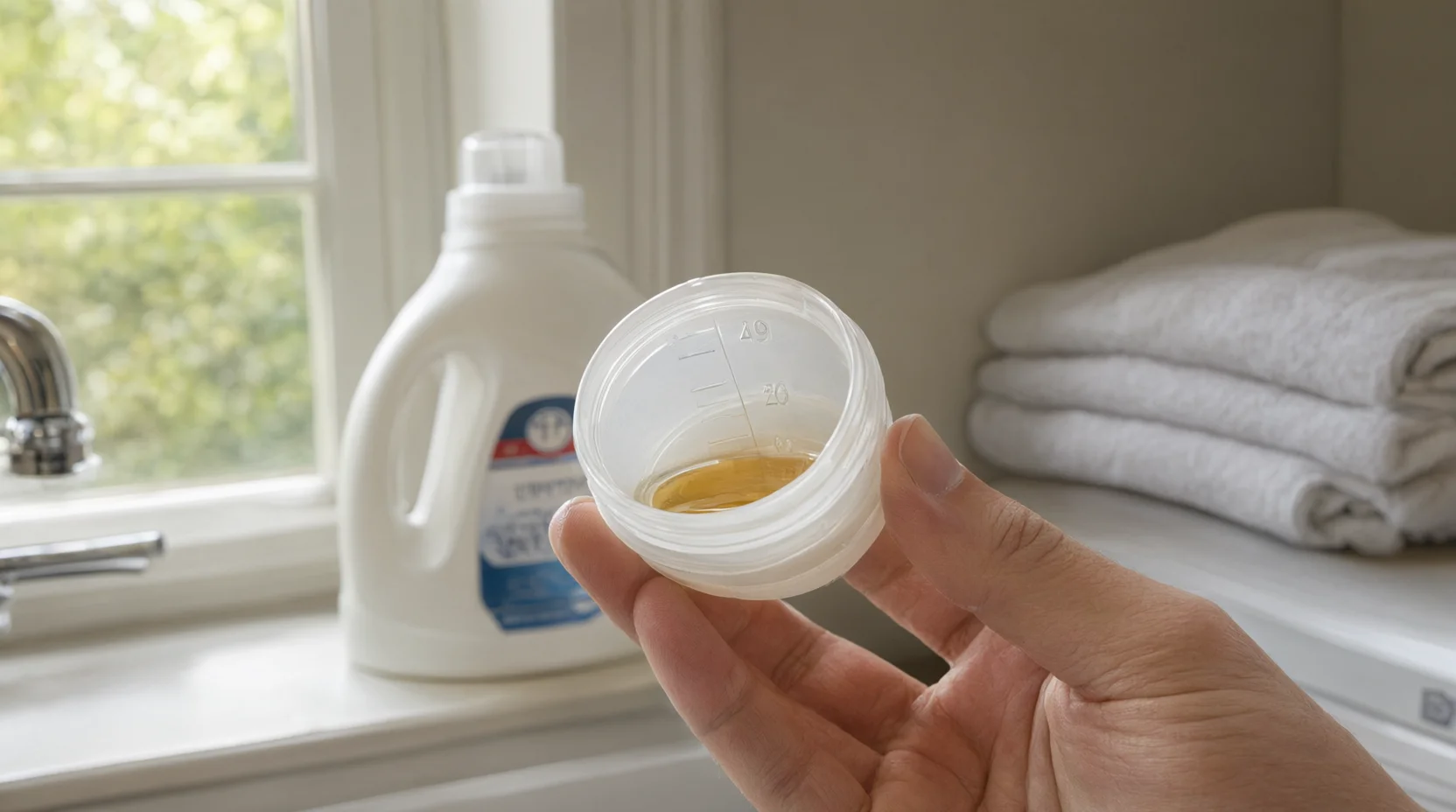
Powder scoops work the same way: the markings indicate load size, and a full scoop is not the default for every wash. Use the scoop that came with the product and follow its printed scale.
Pods, sheets, and tablets are pre-measured. One unit is usually designed for an average load; the package may permit two for large or heavily soiled loads. Pre-measured forms remove guesswork but offer less flexibility for small loads or very soft water, where a partial dose might be enough.
HE vs Standard Washer: Why the Dose Differs
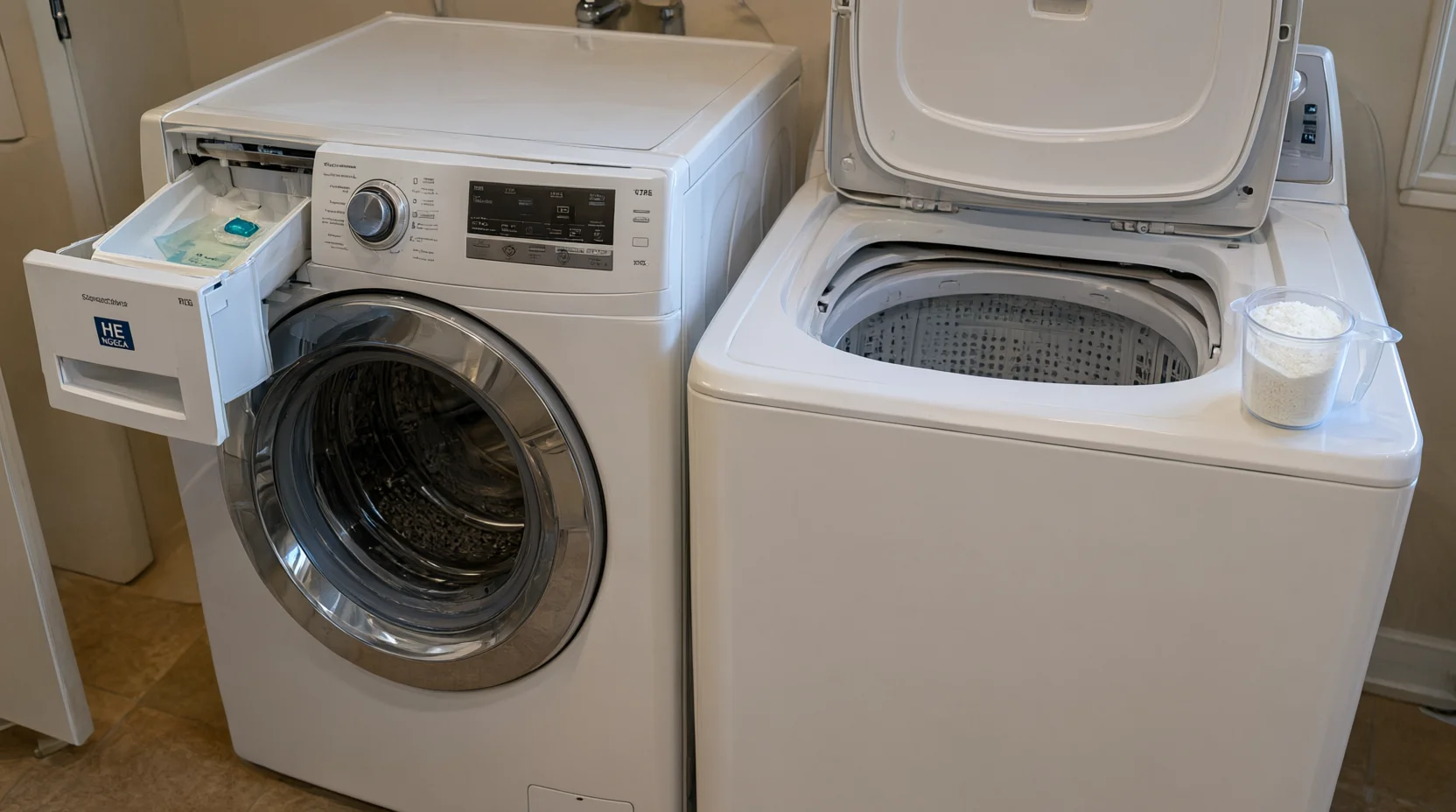
High-efficiency machines use less water per cycle than standard top-loaders. HE detergent is formulated to produce fewer suds so that suds do not interfere with tumbling, load sensing, draining, and rinsing. Using a standard detergent in an HE washer can create excess suds, trigger error codes, and leave residue on clothes.
Because the water volume is lower, the dose volume is generally lower for HE machines than for standard machines for an equivalent load size. That is why the same bottle may list different amounts for HE and standard use, or why an HE-specific product may have a smaller recommended dose.
HE detergent can be used in a standard washer. It will produce fewer suds, and you may need a slight increase per the label guidance to match the cleaning performance you expect. The machine type on the label is a compatibility guide, not a guarantee that one dose fits all conditions.
Adjusting for Load Size, Soil Level, and Water Hardness
Load size is the first adjustment. A large load needs more detergent than a small one, but the relationship is not linear—overdosing a large load can leave residue because the rinse water cannot carry away the excess. Fill the drum loosely; an overloaded machine may not dissolve detergent properly.
Heavily soiled items may need a higher dose within the label's range, or pre-treatment on stains, rather than automatically jumping to the maximum. For normal soil, the middle of the range is often sufficient.
Water hardness affects how well detergent works. Hard water contains minerals that reduce cleaning effectiveness and can leave residue, so you may need a modest increase within the label range or a water softener. Soft water allows you to reduce below the label maximum; experiment downward if clothes rinse clean without stiffness or film.
Signs You're Using Too Much or Too Little
Too much detergent shows up as visible residue on clothes, stiff fabrics, lingering odor, excess suds, or longer rinse cycles as the machine tries to clear the foam. Too little shows up as persistent odors, remaining stains, dull fabrics, or grease that was not removed.
Change one variable at a time—dose, then load size, then water temperature—so you can tell what made the difference. When you switch detergent brands or concentrations, reset to the label minimum and adjust upward only if cleaning is insufficient.
Quick Reference for Common Scenarios
Use these conditional starting points, then adjust based on what you observe in your own machine.
- Small load, soft water, HE machine: Use the minimum dose stated on the label, or slightly less for liquids and powders.
- Large load, hard water, standard machine: Use the upper end of the label's dose range; for very large loads, consider splitting them into two cycles.
- Pods or sheets: Use one for an average load; use two only when the package explicitly allows it for large or heavily soiled loads.
- Using the dispenser: Check your washer manual for the correct drawer compartment and whether the detergent form is compatible with auto-dosing systems.
For pre-measured formats such as laundry sheets, the package guidance on dosing and placement is the most reliable starting point. If you are comparing formats, our guide to laundry pods vs liquid detergent explains how dosing flexibility differs between them.
The most reliable approach is to read the label for your specific product, measure with the supplied tool, and adjust gradually for your machine, water, and load. This routine prevents both waste and under-cleaning without relying on a universal dosage chart, which cannot account for concentration or local water conditions.