
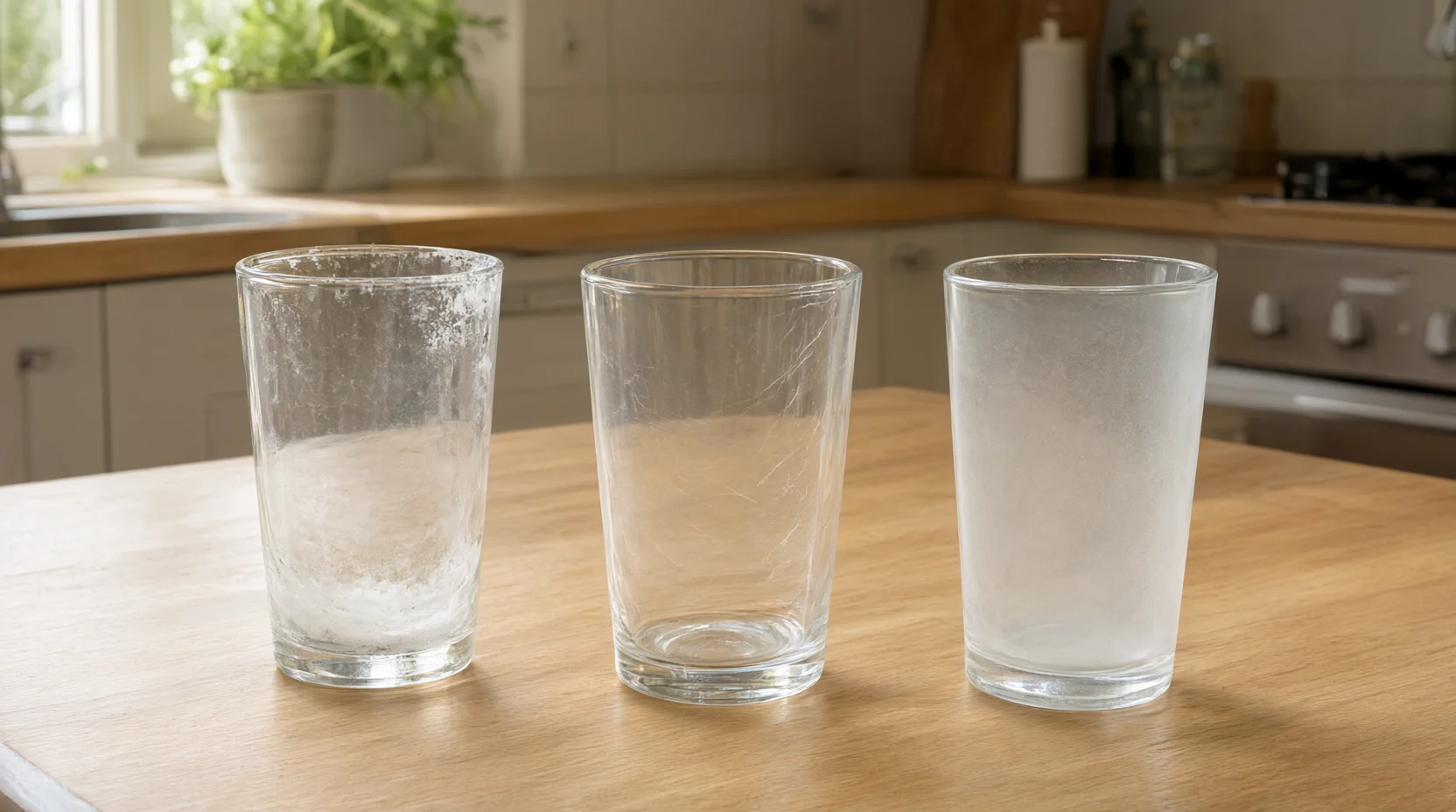
Cloudy glasses usually come from one of three causes: a removable mineral film left by hard water, removable detergent or food residue, or permanent etching—microscopic damage to the glass surface itself. The first two can be corrected; etching cannot. A white-vinegar wipe and a gentle fingernail scratch test will tell you which problem you have, and the fix follows from that result rather than from buying a stronger detergent or a water softener by default.
Why Glasses Look Cloudy: Three Different Causes
The three problems look similar under kitchen lighting, but they behave differently on the surface. Texture is often the first clue: mineral film tends to feel chalky or slightly gritty, while etched glass feels smooth because the damage is below the surface rather than sitting on it.
Hard water film
Hard water carries dissolved calcium and magnesium. When rinse water evaporates, those minerals stay behind as a thin, milky coating that builds up over repeated washes. Film often concentrates on glass bottoms and rims, and the same deposits may appear as scale around the dishwasher door, on the heating element, inside a kettle, or on shower glass—signs that point to water chemistry rather than to the machine or the detergent alone.
Detergent residue
Detergent residue is detergent that was not fully rinsed away, sometimes combined with food soils. Protein and starch residues from milk, egg or starchy foods can bind with hardness minerals and leave a hazier film than minerals alone. Residue may feel slippery or leave streaks, and it can show up when the dispenser is overfilled, glasses block the spray, or the cycle does not match the soil level.
Glass etching
Etching is permanent. Alkaline detergent, high water temperature and long cycles can attack the glass surface, particularly in very soft water where the detergent has few hardness minerals to work against. The result is microscopic pitting that scatters light and looks cloudy no matter how clean the glass actually is. Etched glass cannot be wiped, soaked or washed back to clarity.
Quick Identification Tests
Before spending money on filters, rinse aids or new detergent, run two simple checks on a single cloudy glass. Both take only a few minutes and require nothing beyond white vinegar and your fingernail.
The vinegar test
Wipe or soak the cloudy area with white vinegar for several minutes. If the haze dissolves, mineral film is likely present, because the acid dissolves the calcium and magnesium deposits. If the glass stays cloudy after the vinegar and a normal wash, the surface may be etched. Vinegar is a reasonable first check for mineral film, but it is not a universal residue remover—effectiveness varies with the detergent formula and the soils involved.
The scratch test
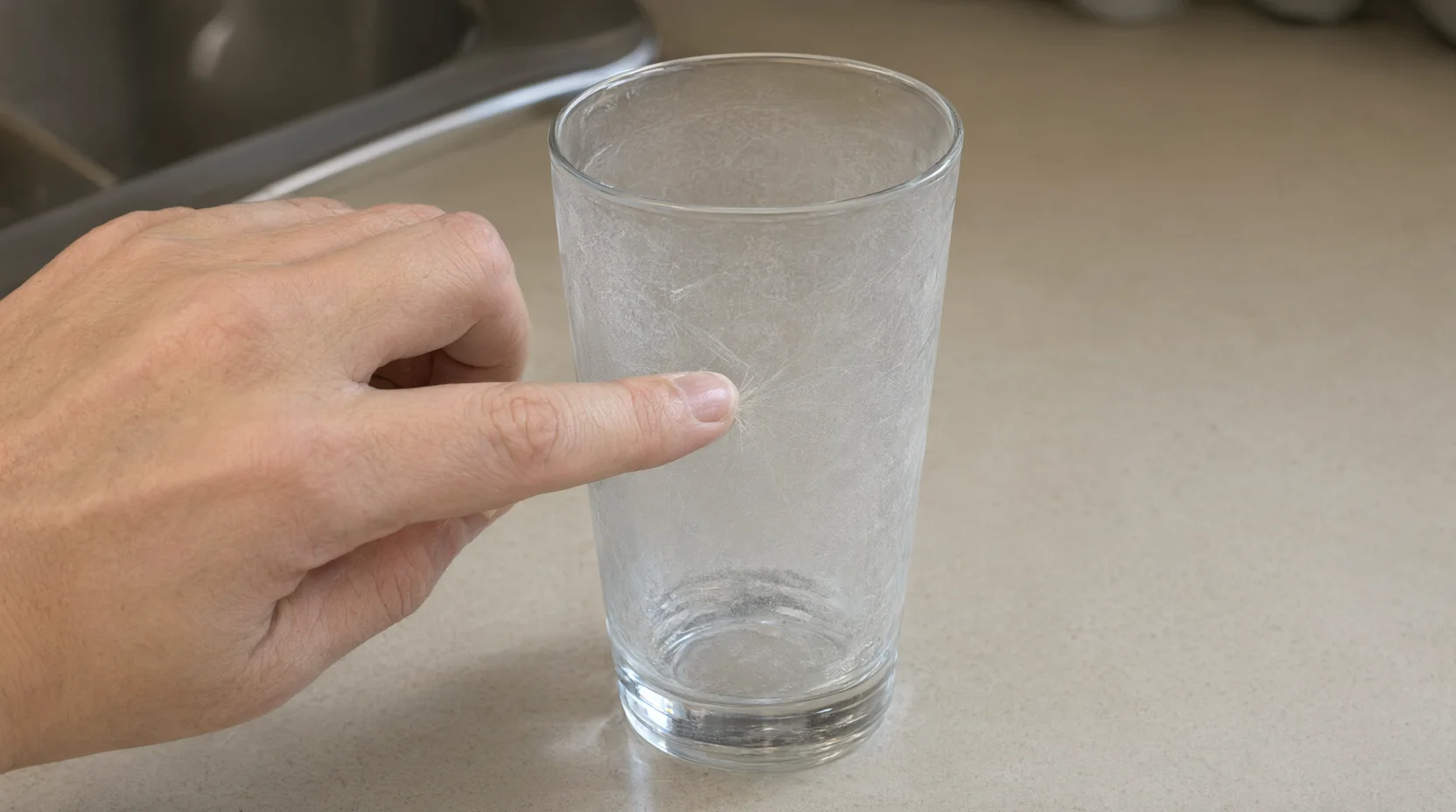
Gently rub the surface with a fingernail. Mineral or detergent film may flake, smudge or feel slightly rough, while etched glass feels smooth and unchanged because the pitting sits below the surface. Pair the scratch test with a visual check: film often builds up unevenly on bottoms and rims, whereas etching tends to produce uniform cloudiness across the glass.
What Each Result Means and How to Respond
The test result should decide your next step. Treating an etching problem with more detergent or a softener will not restore clarity, and treating a mineral problem with a hotter, longer cycle can make film worse.
If vinegar clears the haze
Mineral film is the likely cause. Periodic acid rinses can remove existing deposits, and rinse aid helps water sheet off glass instead of drying into spots. If your water is confirmed hard, a water-softening option may be worth considering—but confirm hardness first rather than assuming it.
If the haze remains and feels unchanged
Etching is the likely cause, and no cleaner will restore clarity. Prevention becomes the only path: use the shortest effective cycle, avoid high-temperature sanitise cycles for routine glass loads, reduce detergent dose in very soft water, and hand-wash delicate or heirloom glassware.
If the glass feels slippery or shows streaks
Detergent or food residue is the likely cause. Check your detergent dose against the machine and local water-hardness guidance, make sure the spray arms are unobstructed and rotate freely, confirm that glasses are not nested or packed where the spray cannot reach them, and check that the rinse aid dispenser is filled.
Prevention Tips by Cause
Once you know which problem you are dealing with, prevention becomes more targeted. The habits below address each cause separately rather than layering every remedy on top of every load.
For hard water
- Keep rinse aid topped up so water sheets off rather than drying into mineral spots.
- Use the detergent amount recommended for your local water hardness rather than a fixed scoop.
- Run hot water at the tap before starting the cycle so the dishwasher begins with hot water.
- Clean the filter and spray arms regularly to remove scale and trapped debris.
For detergent residue
- Do not overfill the detergent dispenser; follow the label and the machine manufacturer's guidance.
- Load glasses so they do not block the spray arms or trap water.
- Select a cycle soil level that matches the load instead of defaulting to the longest programme.
For etching risk
- Use the shortest effective cycle for routine glass loads.
- Avoid high-temperature sanitise cycles unless they are genuinely needed.
- Reduce the detergent dose when your water is very soft.
- Hand-wash delicate, vintage or heirloom glassware.
When to Check Your Water and Machine Settings
If cloudiness persists despite correct product use, the problem may lie outside the detergent itself. Confirming actual water hardness through a local utility report or a test kit prevents wrong fixes based on assumptions. Your dishwasher manual may also list a water-hardness adjustment setting and recommended detergent types for your model.
It also helps to note whether the cloudiness is progressive or sudden. Gradual worsening over months points toward film buildup or slow etching, while a sudden change suggests altered water supply, a new detergent formula, or a machine fault such as a blocked spray arm or a failing rinse aid dispenser. Recording what changed—and when—narrows the diagnosis faster than switching products at random.
The practical takeaway: test before you treat. A vinegar wipe and a fingernail scratch separate removable film from permanent etching, and that single result tells you whether the answer is better rinsing, softer water, gentler cycles, or simply accepting that the glass has reached the end of its clarity.